Electrical calculator for electricians

Voltage drop, wire size and NEC load calcs, offline on the job

ElectroCalc is an electrical calculator with 65 tools and live diagrams. Switch between NEC mode (AWG, kcmil, feet) and IEC mode (mm², metres). Code-based results name the table they come from, every result shows its working, and your calculations save into projects.

Coming soon to theApp Store Get it onGoogle Play
ElectroCalc
Free online tool

Try it in your browser

No download and no sign-up: part of ElectroCalc, free on the web. The app does it offline and adds Pro.

65 calculators in 10 groups

Every electrical calculation in one app

Cables: voltage drop and wire size

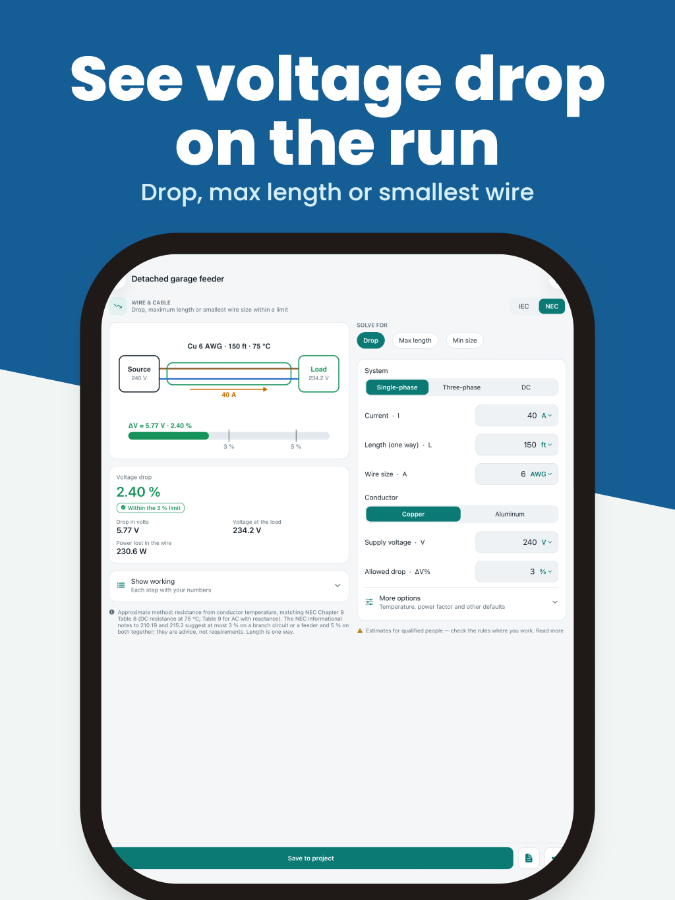
Voltage drop for single-phase, three-phase and DC circuits, in copper or aluminium. Find the drop, the longest run, or the smallest conductor that keeps you under your limit. Cable size picks the conductor from NEC Table 310.16 (75 °C column, per 110.14(C)) or IEC 60364-5-52. Conductor resistance is included. Derating for ambient temperature and grouping is in Pro.

NEC 220 service load calculation (Pro)

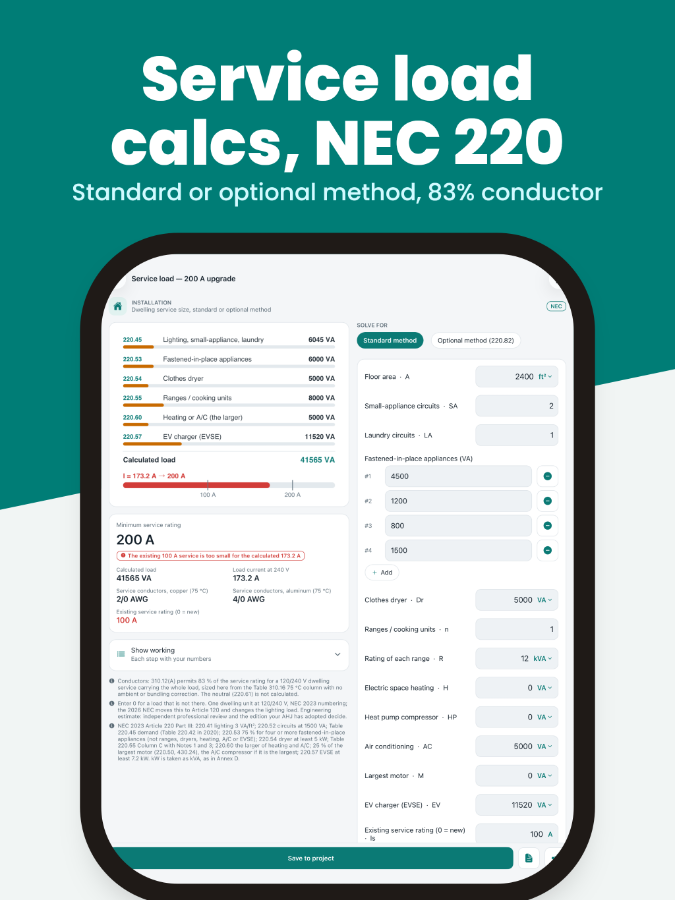
Dwelling service and feeder load under NEC Article 220. The standard method covers general lighting (220.41, Table 220.45), appliances (220.53), dryers (220.54), ranges (Table 220.55), the larger of heating or A/C (220.60), motors (430.24) and EV chargers (220.57). The optional method follows 220.82(B) and (C). It checks the minimum service of 230.79(C), and its results are tested against the NEC Annex D examples.

120/240 V panel schedule (Pro)

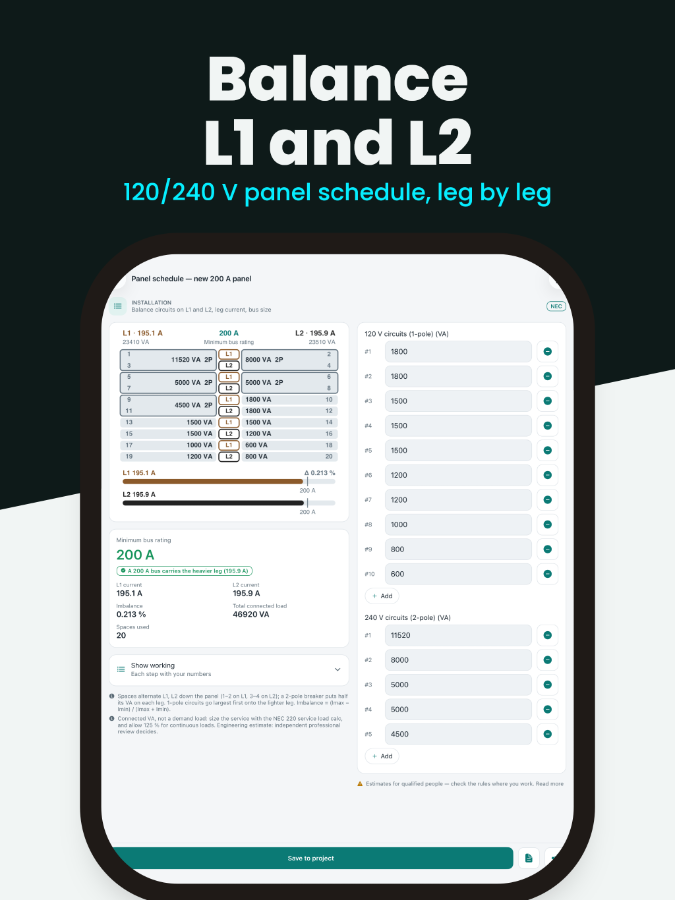
Enter the 1-pole and 2-pole loads of a 120/240 V single-phase panel and ElectroCalc lays out the schedule. Two-pole breakers take one space on each leg, and 1-pole circuits are balanced largest first onto the lighter leg. You get the current on L1 and L2, the imbalance and the smallest common bus rating that carries the heavier leg. This is connected load; use the service load calculator for the Article 220 demand load.

Solar: PV string sizing and the 120% rule (Pro)

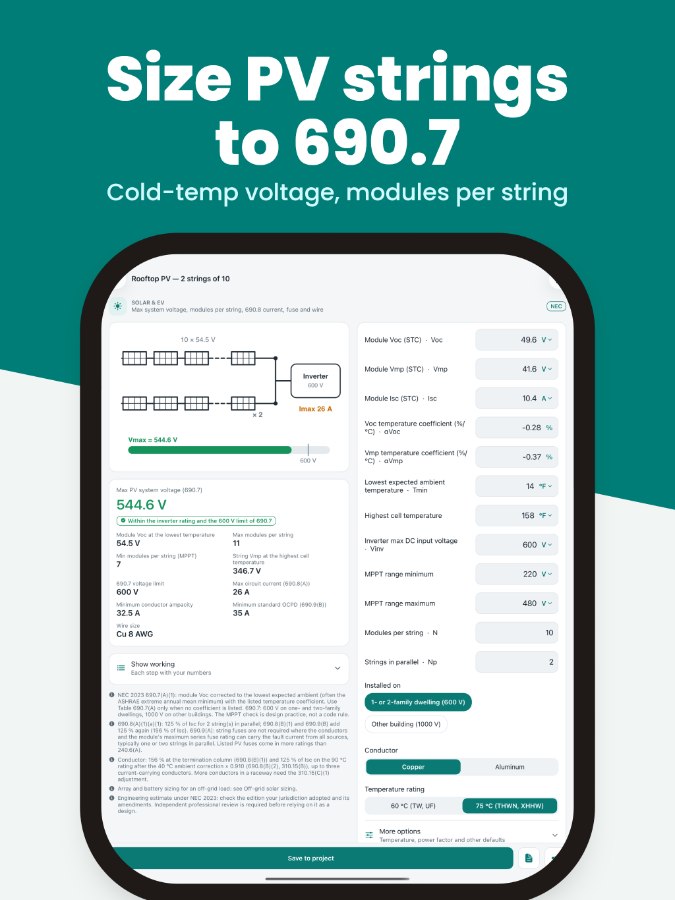
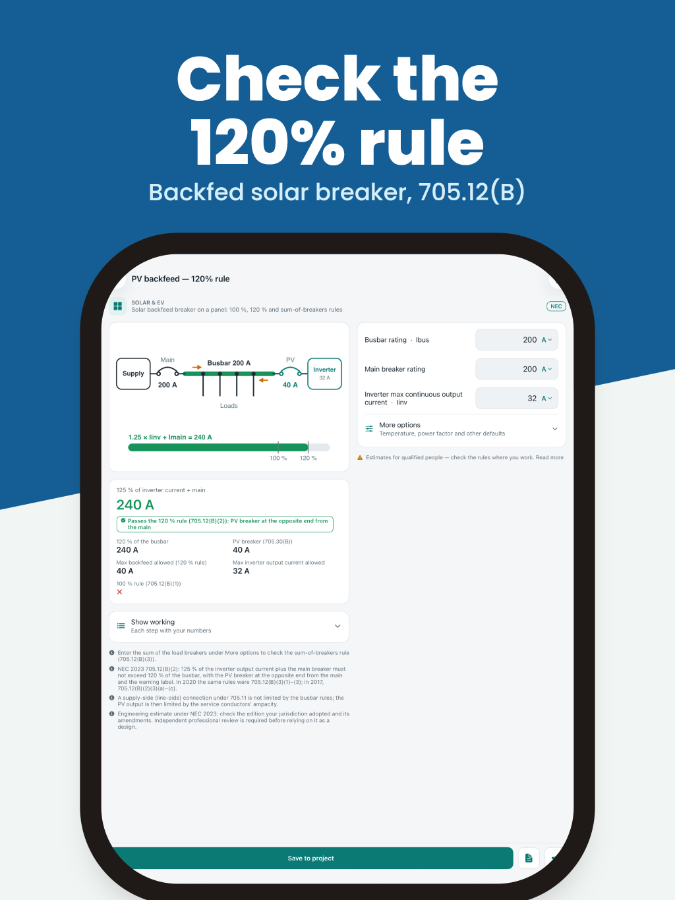
PV string sizing uses the cold-temperature maximum voltage of NEC 690.7(A) and the circuit current of 690.8(A) and (B), with 690.9(B) for overcurrent protection. The busbar check applies the 120% rule of 705.12(B)(2) and the other busbar methods of 705.12(B), and sizes the PV breaker at 125% of the inverter current under 705.30(B), so you can check a backfed solar breaker against the panel before you install it. If the rule fails, it shows the main breaker or busbar that would pass.

EV charger circuit and load management (Pro)

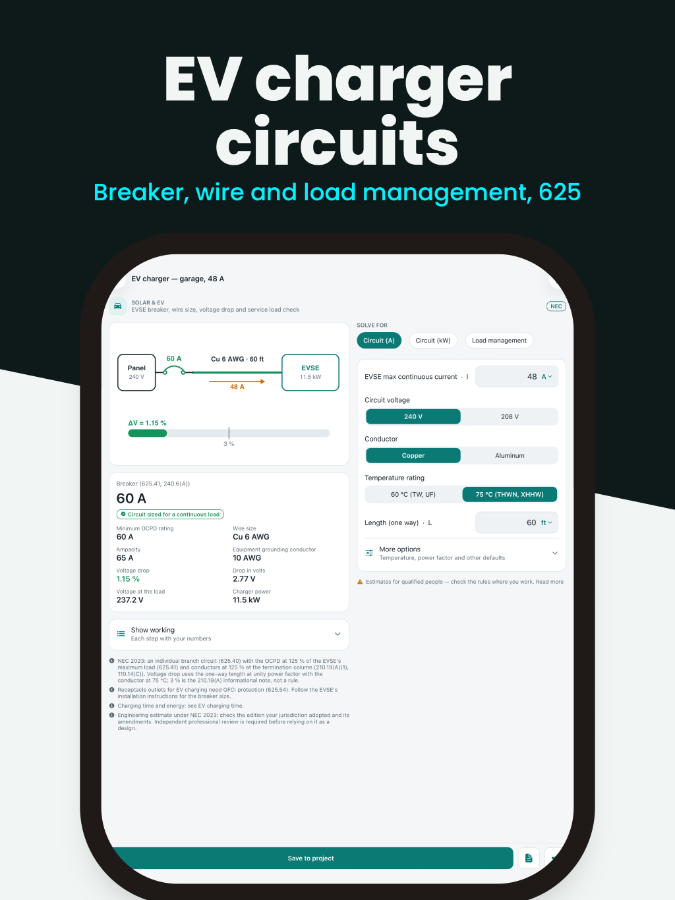
Size an EV charger branch circuit under NEC 625.41 (125% continuous load) and 625.42. It accounts for an energy management system limiting the charger (625.42(A) and (B), 750.30), and it gives the EV load to carry into the service calculation (220.57, 220.70).

Conduit fill, box fill and protection

Conduit fill uses NEC Chapter 9 Tables 1, 4 and 5 for EMT and PVC with THHN/THWN-2. Box fill follows Table 314.16(B). The protection tools cover breaker and fuse selection (240.4, 240.6(A)), short-circuit current, RCD/GFCI selection, equipment grounding conductor size (Table 250.122), earth rod resistance and a single-line diagram with the fault level at every board. All of these are Pro.

Motors, transformers and power factor

Motor full-load current, with the NEC Table 430.248 or 430.250 current that 430.6(A)(1) requires, motor speed and slip, starting current, starter and protection sizing (430.22, 430.32, Table 430.52(C)(1)) and running a three-phase motor on single phase. Transformer current and ratio, fault current, losses and efficiency, and power factor correction.

Basics, AC circuits, electronics and reference

Ohm's law and power, series and parallel resistors, voltage and current dividers, single- and three-phase power, the power triangle, RLC impedance, resonance and neutral current. Resistor and capacitor codes, LED resistor, 555 timer, LM317, battery and UPS runtime, off-grid solar, EV charging time, a unit converter and AWG to mm². These are all free.

Live diagrams

A look inside

Method and standards

How ElectroCalc calculates

NEC 2023 and IEC 60364 tables

NEC mode uses 2023 numbering and notes the 2020 number where a section moved. Its tables include 310.16, Chapter 9 Tables 1, 4 and 5, Article 220, Table 250.122 and Tables 430.248/430.250. IEC mode uses IEC 60364-5-52 Annex B: Tables B.52.2 to B.52.5 for installation methods A1, A2, B1, B2 and C, with the B.52.14 ambient and B.52.17 grouping factors. Conductor sizes run from 14 AWG to 1000 kcmil and follow IEC 60228 in mm².

Results name their table and show their working

A result is not just a number. A code-based result names the table and column it used, for example "310.16 · 75 °C". The working card shows each formula step with your values in it, so you can check the answer or explain it to an inspector.

Engineering estimates for qualified people

ElectroCalc gives engineering estimates for qualified people. Results depend on the inputs and assumptions shown. They are not a design certificate and do not replace the code your jurisdiction has adopted, manufacturers' data or an inspection by a competent person. Isolate and prove dead before working on any circuit.

Free, and Pro with one payment

41 of the 65 calculators are free, and you can save 50 calculations in 3 projects. Pro is one payment, yours to keep, with no subscription. It adds the protection, derating, single-line, NEC 220, panel schedule, solar and EV tools, unlimited projects, PDF reports with diagrams, your company name, logo and job-site photos, CSV export, side-by-side scenarios and no ads.

Frequently asked questions

Is there a free NEC electrical calculator app?

Yes. ElectroCalc is free to download. 41 of its 65 calculators are free, including voltage drop, cable size, Ohm's law, motor current and the AC circuit tools. Pro is a one-off purchase for the advanced NEC, protection, solar and EV tools.

Does ElectroCalc work offline?

Yes. Every calculation runs on your phone, so it works in a basement, a crawl space or a site with no signal. You need no account and no connection to calculate.

How do I calculate voltage drop and wire size under the NEC?

Open Voltage drop in NEC mode and enter the circuit (single-phase, three-phase or DC), the load current, the one-way length in feet and the conductor. ElectroCalc gives the drop in volts and percent. It can also find the smallest conductor that keeps the drop under your limit. Cable size then checks the ampacity against Table 310.16 (75 °C column). You can try the voltage drop calculator free in your browser.

Can it do an NEC 220 residential service load calculation?

Yes, in Pro. The service load calculator follows NEC Article 220 for dwellings, with both the standard method and the optional method of 220.82. It covers general lighting, small-appliance and laundry circuits, fixed appliances, dryers, ranges, heating or A/C, motors and EV chargers. Its results are checked against the NEC Annex D examples.

How does the 120% rule for solar work?

Under NEC 2023 705.12(B)(2) (705.12(B)(3)(2) in the 2020 edition), when the solar backfeed breaker sits at the opposite end of the busbar from the main breaker, 125% of the inverter output current plus the main breaker rating may not exceed 120% of the busbar rating. ElectroCalc's busbar check (Pro) runs this check and the other 705.12(B) methods for you, and if it fails it shows the main breaker or busbar rating that would pass.

How do I size an EV charger circuit?

NEC 625.41 treats an EV charger as a continuous load, so the branch circuit is sized at 125% of the charger's rated current. An energy management system can limit that current under 625.42. ElectroCalc's EV charger circuit tool (Pro) applies both and gives the load to use in the service calculation.

Does it support both NEC and IEC?

Yes. Switch the app between NEC mode (AWG, kcmil, feet) and IEC mode (mm², metres). Each tool follows the NEC, IEC or both, depending on the rules it applies. NEC mode uses 2023 numbering. IEC mode uses the IEC 60364-5-52 tables.

What is free and what does Pro add?

Free: 41 calculators, live diagrams, the working behind every result and 50 saved calculations in 3 projects. Pro, one payment with no subscription: the protection, derating, single-line, conduit fill, NEC 220 service load, panel schedule, solar and EV tools, unlimited projects, PDF reports with your logo and job-site photos, CSV, scenario comparison and no ads.